
 English
 Español
 العربية
In the world of heavy industrial engineering—where mining crushers, offshore cranes, and rolling mills operate under continuous multi-ton stresses—power transmission is not just about moving torque. It is about total system integrity.
While individual components like BEVEL GEARS, SPUR GEARS, Cylindrical Gears, and Helical Gears form the mechanical muscle of any drive, true operational longevity is determined by how seamlessly these gears interact with their supporting shafts. Integrating custom gear trains with specialized drive shafts, industrial shafts, spline shafts, and Herringbone Gear shafts within a unified housing assembly represents one of the most critical engineering challenges facing modern procurement teams.
For global purchasing managers and chief engineers, sourcing these heavy-duty transmission assemblies overseas involves navigating a complex matrix of metallurgical standards, thermal stress controls, and long-term financial commitments. This guide explores how transitioning from component-level purchasing to integrated drive system sourcing protects project quality and streamlines operational cash flow.
1. System-Level Synchronization: Beyond Individual Gear Machining
A common failure point in heavy industrial machinery is not the breakage of a single gear tooth, but a mismatch in tolerance stack-up between the gear and its supporting shaft. Sourcing gears from one machine shop and drive shafts from another frequently leads to micro-misalignments, localized stress concentrations, and premature bearing fatigue.
+------------------------------------------------------------------------------------------------+
|                     SYSTEM-LEVEL INTEGRATION vs. COMPONENT SOURCING                            |
+----------------------+---------------------------------------+---------------------------------+
| Sourcing Approach    | Operational Characteristics           | Risk & Efficiency Profile       |
+----------------------+---------------------------------------+---------------------------------+
| Component Sourcing   | Sourcing gears and shafts from        | High risk of tolerance stack-up,|
|                      | separate, independent machine shops   | assembly delays, split warranty |
+----------------------+---------------------------------------+---------------------------------+
| Integrated System    | Single-source manufacturing of matched| Zero assembly misalignment,     |
| Sourcing             | gear and shaft sets per blueprint     | optimized contact patterns, 100%|
|                      |                                       | single-point accountability     |
+----------------------+---------------------------------------+---------------------------------+
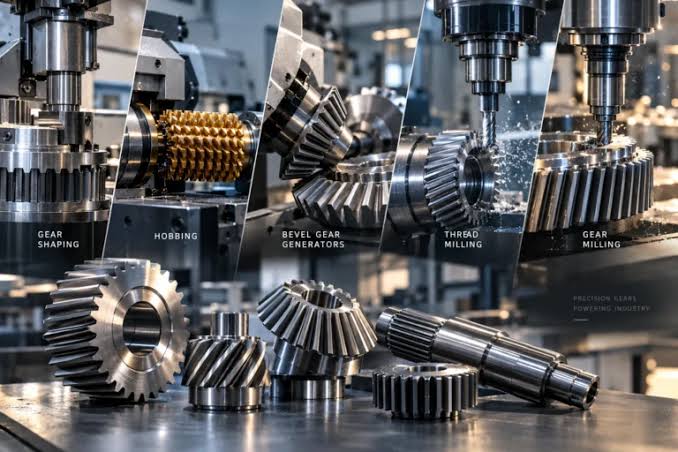
The Synergy of Matched Transmission Sets
- Bevel & Helical Gear Synchronization: When a BEVEL GEAR or Helical Gear operates under heavy load, it generates significant axial thrust forces. If the mating industrial shaft or spline shaft lacks the exact journal concentricity or shoulder squareness required by the engineering drawing, the gear teeth will shift out of their optimal contact pattern, accelerating wear.
- Herringbone Gear Shafts & Zero Axial Force: Herringbone Gear shafts eliminate axial thrust entirely through opposing helix angles. However, their manufacturing requires extreme precision: the left and right tooth profiles must be perfectly symmetrical relative to the shaft axis. Machining the shaft body and double-helical teeth on a single setup ensures absolute concentricity that cannot be matched by pressed-fit assemblies.
- Spline Shaft Fitment: The torsional performance of a drive shaft depends on the precision of its splines. Whether involute or straight-sided, spline pitch errors can cause localized binding or excessive rotational play, both of which degrade system efficiency during high-torque reversals.
By adopting an integrated manufacturing strategy, every gear, shaft, and keyway is machined and verified as a co-dependent system prior to shipment.
2. Guarding the Quality Baseline: The Cost of Compromise in Heavy Industry
In high-output industrial applications, the purchase price of a gear or shaft represents a fraction of its potential failure cost. A single night of unplanned downtime on a quarry conveyor or steel mill drive line can surpass the entire procurement budget for the transmission assembly.
Eliminating Hidden Failure Modes
Guarding the quality baseline requires rigorous metallurgical and metrological controls at every stage of production:
- Metallurgical Integrity & Traceability: Raw material selection forms the first line of defense. Premium alloy steels—such as 20CrMnTi, 42CrMo (4140), and 34CrNi3Mo—must undergo 100% Ultrasonic Testing (UT) to verify freedom from internal voids, inclusions, or hydrogen flakes before any machining begins. Every batch must be backed by EN 10204 3.1 Material Test Certificates (MTC).
- Controlled Case Hardening: Heat treatment gives gears and shafts their wear-resistant surface and impact-resistant core. Utilizing atmosphere-controlled carburizing and quenching lines ensures precise Effective Case Depth (ECD) control. Post-heat-treatment metallographic testing verifies that microstructures are free from excessive retained austenite or surface decarburization.
- High-Precision Metrology: Advanced Gear Measuring Centers (GMC) and Coordinate Measuring Machines (CMM) analyze tooth profile (Ff), lead (Fβ), and pitch errors (Fp) to confirm compliance with international standards such as DIN Class 6 or AGMA Class 10+.
3. Financial & Supply Chain Flexibility for Enterprise Clients
Beyond technical capabilities, global procurement directors require supply chain partners who understand the commercial realities of large-scale industrial projects.
Easing Capital Strains
Capital tie-up during long-lead manufacturing projects can restrict an enterprise’s operational agility.
- Flexible Milestone Terms: Established manufacturers with strong capital foundations can offer structured settlement frameworks—including Letters of Credit (L/C), bank acceptance bills, or milestone-based progress payments.
- Working Capital Optimization: Sharing the financial load of raw material stocking and long-lead production allows enterprise buyers to maintain healthy cash reserves for ongoing site installation, commissioning, and core R&D activities.
Streamlining Technical Communication
Cross-border procurement often suffers from delays caused by misread blueprint callouts, geometric dimensioning and tolerancing (GD&T) misunderstandings, or regional standard conversions (e.g., matching Chinese GB or Japanese JIS steels to European DIN or American ASTM equivalents).
Partnering with an engineering-driven supplier featuring bilingual technical support eliminates these friction points. From conducting Design for Manufacturability (DFM) reviews to providing structured Production Milestone Tracking reports, an experienced team saves valuable engineering hours and keeps project timelines on schedule.
4. Key Procurement Checklist for Integrated Drive Assemblies
When evaluating global manufacturing partners for custom gear and shaft assemblies, consider the following technical and commercial criteria:
| Evaluation Criteria | Technical Baseline Requirements | Value Impact |
| Blueprint & DFM Capability | Ability to review complex assembly drawings, GD&T, and perform DFM optimization | Prevents costly field re-machining and assembly interference |
| Material Quality & UT | Full raw material traceability with EN 10204 3.1 MTCs and UT flaw detection | Guarantees structural integrity under heavy impact loads |
| Integrated Gear-Shaft Machining | In-house capability for bevel, spur, helical gears, plus spline and industrial shafts | Ensures concentricity, precise contact patterns, and balanced drive trains |
| In-House Metrology Fleet | Gear Measuring Centers (GMC), CMM, and NDT (Magnetic Particle & Ultrasonic) | Provides quantitative verification of DIN/AGMA precision classes |
| Commercial Terms | Flexible settlement terms (L/C, milestone payments, credit support for key accounts) | Reduces upfront cash exposure and optimizes working capital |
5. Building a Resilient Supply Chain Alliance
Selecting a manufacturing partner for BEVEL GEARS, SPUR GEARS, Cylindrical Gears, Helical Gears, drive shafts, industrial shafts, and spline shafts is a strategic investment in equipment reliability.
By prioritizing system-level blueprint customization, enforcing strict metallurgical quality baselines, leveraging robust supply chain integration, and utilizing flexible commercial terms, enterprise buyers can significantly reduce total cost of ownership while protecting operational continuity.