
 English
 Español
 العربية
A comprehensive guide to the drive shaft, covering definition, components, and working principles.
What is a drive shaft?
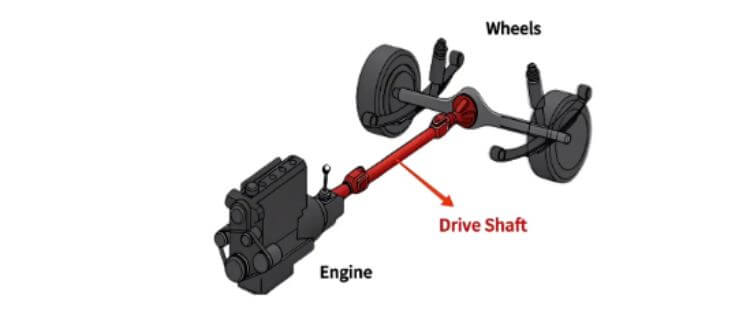
A drive shaft is a mechanical shaft used to connect two separated rotating parts. It transmits rotary power and torque from one end (input end) to the other end (output end). Simultaneously, it can automatically compensate for angular deviation and axial length change caused by relative movement between the two connected parts.
Given the widespread use of drive shafts in automobiles, many people mistakenly believe drive shafts only refer to the shafts connecting gearboxes and driving wheels on vehicles. In fact, industrial equipment is equipped with special industrial drive shafts (universal drive shafts) for long-distance power transmission. However, it should be noted that fixed transmission shafts sealed inside reducers and gearboxes do not belong to drive shafts.
What is a drive shaft composed of?
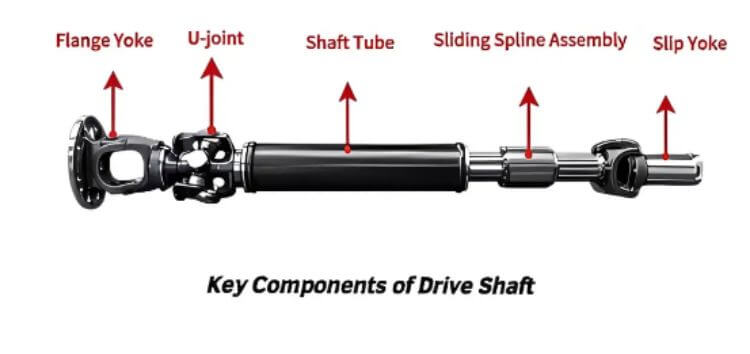
A drive shaft is a complete assembly made of multiple parts, not a single rigid shaft. It mainly consists of 5 core components as follows:
Shaft Tube
The shaft tube is the core component of a drive shaft to bear torque and transmit power. It determines the overall rigidity, service life and dynamic balance performance of the whole shaft. Most drive shafts adopt a hollow seamless steel tube structure. It balances high torsion resistance and lightweight advantages. Some high-end vehicles and precision industrial equipment use aluminum alloy or carbon fiber shaft tubes to further reduce overall weight and suppress operating vibration.
Universal Joint
The universal joint is also a core component of a drive shaft to adapt to angular deviation. It is mainly composed of a cross shaft, a needle roller bearing, an oil seal and a dust cover. This structure can compensate for angular deviation generated by vehicle suspension bounce and equipment vibration. Even if the connection angle at the two ends changes dynamically, it can guarantee continuous and stable power transmission.
Sliding Spline Assembly
The sliding spline assembly is the other core component of a drive shaft to adapt to the axial distance change between the input end and the output end. It consists of internal and external involute splines. This component can stretch freely to adjust overall length. It prevents the drive shaft from extrusion, deformation or even fracture due to the length limit. At the same time, the spline structure ensures stable torque transmission during the sliding movement.
Flange Yoke and Slip Yoke
Flange yokes and slip yokes are connecting components of the drive shaft. The yoke structure ensures no offset during power transmission. They are welded or otherwise fixed to the ends of the shaft tube and secured via bolts to the transmission, transfer case, differential, or other industrial power equipment.
Center Support Bearing (Only used on Two-piece Drive Shaft)
The center support bearing is a special matching component for two-piece drive shafts. It is composed of a bearing core, a rubber shock absorption base and a fixing bracket. This component is installed in the middle position of two-piece drive shafts. It supports long shaft tubes, reduces shaft bending deformation and suppresses high-speed vibration and shaking. It is mostly used on long-wheelbase trucks, large passenger cars and heavy industrial equipment.
How does a drive shaft work?
1. Power Input
The power source (gearboxes/transfer cases for automobiles; motors/reducers for industrial equipment) outputs rotary torque, which is transmitted via a flange connection to the driveshaft’s flange yoke. Thereby, power enters the drive shaft assembly and drives the whole shaft to rotate synchronously.
2. Dynamic Angle Compensation by Front Universal Joint
During equipment operation, vibration, load impact, installation alignment deviation or structural displacement will form an included angle between the power input end and the drive shaft. The front universal joint adapts to angle changes in real time. It allows the drive shaft to rotate stably under non-straight working conditions. It avoids power jamming and transmission blockage.
3. Long-distance Torque Transmission by Shaft Tube
Power is transmitted to the middle hollow shaft tube via universal joints. The high-strength shaft tube bears all torsion loads, enabling torque transmission over medium-to-long distances and overcoming the problem that power sources and executing mechanisms cannot connect directly due to excessive spacing.
4. Self-adaptive Length Change by Sliding Spline Assembly
Whether due to automobile suspension movement, industrial equipment vibration, thermal expansion and contraction, or structural deformation, the transmission distance at two ends will change in real time. The sliding spline assembly slides freely along the axial direction while continuously transmitting torque. It automatically adjusts the total length of the drive shaft to compensate for equipment displacement, thereby preventing the shaft from deforming or fracturing under compressive or tensile loads.
5. Secondary Angle Compensation by Rear Universal Joint
When power is transmitted to the output end, the rear universal joint compensates for the dynamic angular offset generated by the load at the output end again. It realizes synchronous angle compensation on both input and output ends of the drive shaft. Torque is transmitted evenly and stably without obvious shaking in the whole process.
6. Power Output to Drive Load
Stable torque is transmitted to the end effector via the rear flange yoke:
Automobile working condition: Torque enters the differential and drives the wheels to rotate;
Industrial working condition: Torque is transmitted to conveying rollers, fan impellers, crushers and various main machines to drive equipment operation.
7. Stability Auxiliary for Long Shafts (General)
Vehicles with long wheelbases and industrial equipment with large spans adopt segmented drive shafts fitted with center support bearings in the middle. This component supports long shafts, reduces bending deformation and weakens high-speed resonance. It guarantees stable transmission under long-distance and high-speed working conditions.