
 English
 Español
 العربية
Are you struggling to decide which forging method to choose for gear blanks? As common gear forging methods, closed-die forging and open-die forging have obvious differences in application scenarios and process characteristics. I will elaborate on the similarities, differences, and key selection points of these two processes, and help you make a suitable choice.
What Is Closed-Die Forging?
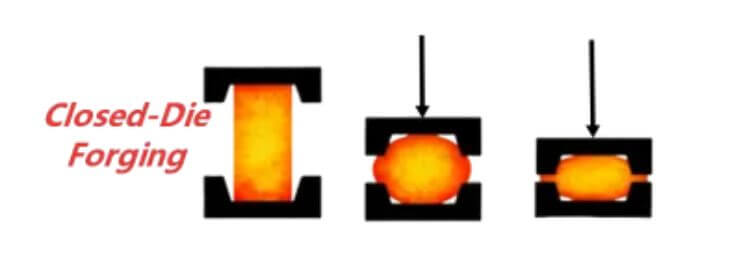
Closed-die forging is a commonly used forging process in gear manufacturing. It means placing the heated metal blank into a pre-customized closed die.
Pressure is applied by closing the upper and lower dies to make the metal flow and fill the die cavity, so as to obtain forgings close to the final shape.
After gear blanks are processed by closed-die forging, their outline can be close to the finished product, which effectively reduces subsequent processing work. Closed-die forging features high precision and production efficiency. Therefore, it brings obvious cost advantages and economic benefits for small-sized gears that need mass production.
What Is Open-Die Forging?
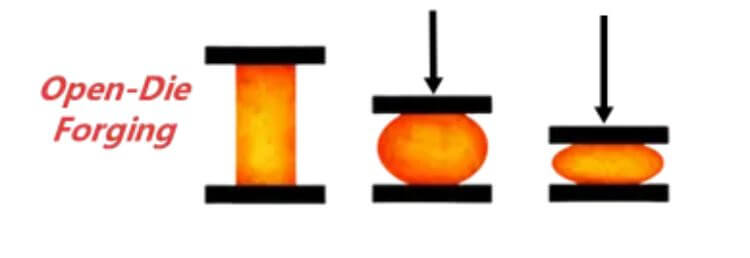
Open-die forging is widely used to produce gear blanks in gear manufacturing and is also a type of forging. It places heated metal blanks on an open anvil surface.
A forging hammer or press repeatedly strikes and compresses the blanks to make the metal produce plastic deformation gradually. Since open-die forging does not adopt closed forming dies, the material can flow freely without geometric restrictions.
Open-die forging cannot form gear tooth structures directly, so follow-up machining is usually required to meet dimensional accuracy and tooth profile requirements. It needs low die investment and offers high production flexibility, and is often used for manufacturing large, simple-structured gears in small batches.
What Are the Similarities Between Closed-Die Forging and Open-Die Forging?
Process Attribute
Both closed-die forging and open-die forging belong to the hot forging process, and are applied in the forming procedure of gear blanks.
Core Goal
Whether it is closed-die forging or open-die forging, both aim to refine metal grains through forging, improve the strength and toughness of materials, so as to obtain forged blanks with good performance and lay a foundation for subsequent processing.
Processing Principle
Both forging methods induce plastic deformation in the metal through external forces such as hammering or pressing, and help reduce the effect of internal material defects.
Requirement for Subsequent Machining
Gear blanks made by either closed-die forging or open-die forging cannot meet the finished product standard directly. Subsequent machining is required to satisfy the requirements of gear precision and tooth profile.
What Are the Differences Between Closed-Die Forging and Open-Die Forging?
Although open-die forging and closed-die forging share many similarities in basic processing logic, they have obvious differences in the core forming method and principle, which are mainly reflected in the following aspects.
Forming Constraint Mode
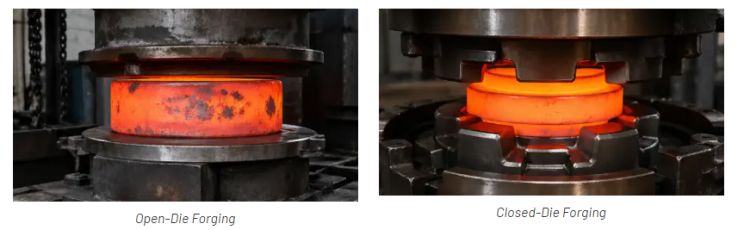
- Closed-die forging relies on closed forming dies. The final shape is strictly limited by the die, delivering high forming accuracy and good consistency.
- Open-die forging adopts an open forming method. It does not depend on the constraint of the dies, and the blank can deform freely under external force.
Metal Flow Mode
Metal in closed-die forging flows directionally guided by the geometric shape of the die until it fits the die profile.
Metal in open-die forging can flow freely in all directions. The shape is able to change more flexibly in its deformation process.
Process Control Mode
The shape of forgings in closed-die forging is directly determined by the die structure. Plastic deformation is usually completed after one or a few presses with little manual intervention.
Open-die forging relies heavily on operator control. The forging takes shape gradually and section by section through repeated local pressure.
The above analyzes the differences between open-die forging and closed-die forging from the perspective of forming principles.
In order to illustrate the overall difference between the two forging processes in an intuitive manner, I will make a comprehensive comparison from four aspects: application capability, forming quality, production characteristics, and economy in the next section.
| Open-Die Forging | Closed-Die Forging | |
|---|---|---|
| Applicable Size Range | Large-sized, heavy-duty, or extra-large specification forgings | Mainly small and medium-sized forgings |
| Forming Complexity | Only suitable for simple blank shapes | Can form blanks close to the final gear profile |
| Application Scenarios | Large gear shafts, heavy-duty transmission gears | Automotive gears, construction machinery gears |
| Dimensional Accuracy | Low with large dimensional deviation | High with good dimensional stability |
| Machining Allowance | Large | Small |
| Suitable Production Scale | Single piece or small-batch production | Mass and large-scale production |
| Process Flexibility | High; working procedures can be adjusted as needed | Low; dependent on dedicated dies |
| Manufacturing Cost | No die cost; low cost for small batches | High upfront die cost; low unit cost in mass production |
| Material Utilization Rate | Relatively low | High |
How to Choose Between Closed-Die Forging and Open-Die Forging?
How to choose a suitable forging method for gears? From the following four factors, we can decide the proper method. They include gear size, production batch, precision requirement, and cost budget.
Based on Size Requirement
Large-diameter, large-module or heavy-duty gears → Open-die forging
Gears of small to medium and medium-large sizes → Closed-die forging
Based on Production Batch
Custom gears in single piece or small batches → Open-die forging
Standardized gears in mass production → Closed-die forging
Based on Gear Precision
High requirements for tooth profile precision, dimensional consistency, and surface quality → Closed-die forging
Low precision requirements, only rough blanks needed, and large machining allowance allowed → Open-die forging
Based on Cost Budget
Long-term mass production needed to reduce subsequent machining costs → Closed-die forging
Low initial investment and short production cycle preferred → Open-die forging
In short:
Large size, small batch, and simple structure — Choose open-die forging.
Small to medium size, mass production, complex structure, and high precision requirements — Choose closed-die forging.